
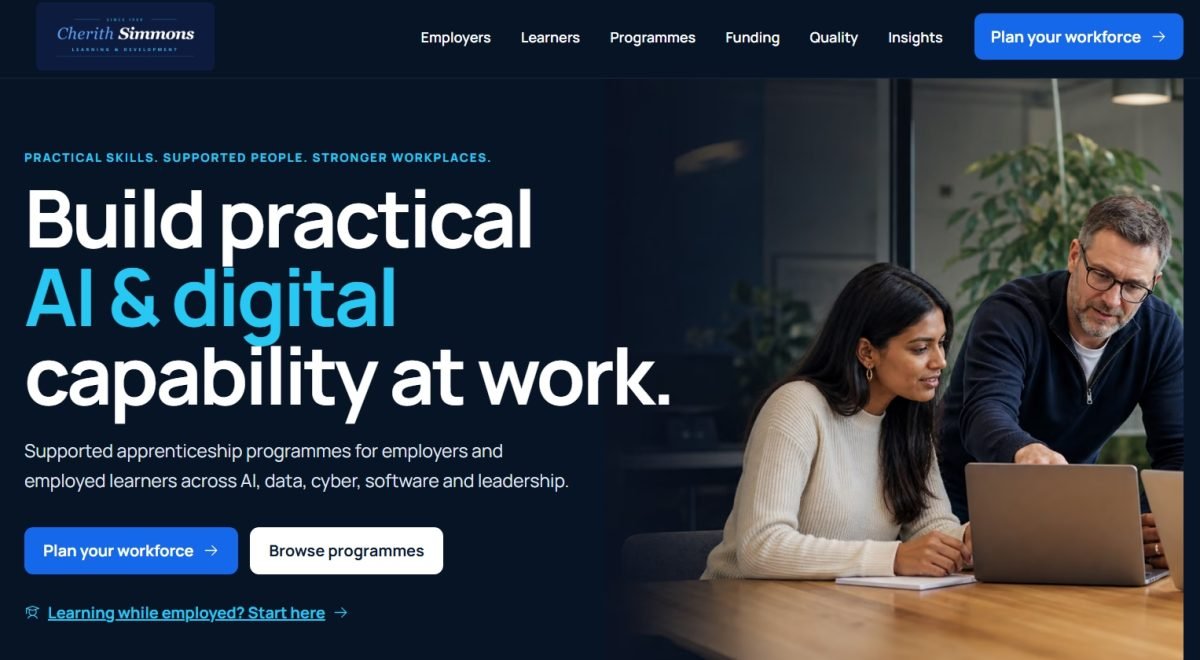
The workplace is undergoing rapid change. In many organisations artificial intelligence, data, cybersecurity, software development and effective leadership are becoming more important. Both employees and employers can make use of developing these abilities as a practical means of preparing for the changing demands of the workplace.
Cherith Simmons’ Workplace Apprenticeships in AI, Digital & Leadership offer a form of professional development based on work experience. Instead of entirely separating learning from everyday duties, the apprenticeship scheme combines employment with organized training and the chance to put new knowledge into practice in a real work environment.
Cherith Simmons Learning & Development offers apprenticeship programmes in a number of fields such as AI and data, cyber security, software, DevOps, business analysis and leadership. The company’s website describes itself as an active learnig
What Are Workplace Apprenticeships?
A workplace apprenticeship involves carrying out a real job alongside receiving structured education. As they work in the right kind of position, the apprentice acquires the occupational knowledge, skills and behaviours.
An apprenticeship is thus unlike a conventional course that is based only in the classroom since learning can be linked directly to the duties performed in the workplace, to the projects and to the business challenges.
An employee can thus have a structured way of acquiring new professional skills, while an employer can use it to develop their existing employees and at the same time align learning with the requirements of the organisation.
The specific requirements, the way funding is arranged and the eligibility criteria will vary according to the apprenticeship standard and the present UK government rules, so both employers and learners should look at the most recent official guidance before coming to a decision.
What are the reasons for looking into apprenticeships in the fields of AI, digital technology, and leadership?
Various organisations have different requirements when it comes to skills, but some fields are especially relevant to today’s workplaces.
- AI and Data Skills
Artificial intelligence and data are being used more and more to support business processes, analysis and decision-making.
Cherith Simmons has listed among them an apprenticeship in the Level 4 AI Practitioner programme and one in the Level 7 AI & Data Specialist programme. Since the programmes are designed to cater to different stages of professional development, the right choice will vary according to the learner’s position, their experience and their eligibility.
The learning involved in AI can include subjects such as machine learning, data analysis, Python, natural language processing, prompt engineering and responsible AI, according to the programme.
What matters to employers is not just whether AI is in vogue but whether the organisation has certain roles or business problems which can benefit from AI and data capabilities in a practical way.
- Skills in digital and technology
Digital apprenticeships can help employees who are working with software, infrastructure, data and cybersecurity.
Cherith Simmons currently lists programmes including:
Software Developer
DevOps Engineer
Cyber Security Technologist
Data Engineer
Software Tester
Business Analyst
Multi-Channel Marketer
The programmes include a variety of technical and business functions, so that employers can decide on development options in accordance with the duties of specific roles.
For instance, an apprenticeship in software development would be suitable for a person who is developing applications, whereas one in cybersecurity is more in line with the task of protecting systems and information.
- Leadership and Management
Technology skills are only one aspect of workplace development; organisations also need individuals who are able to communicate effectively, make decisions, manage teams, and support change.
Cherith Simmons offers leadership and management apprenticeships covering the range from Level 3 Team Leader to Level 5 Operations Manager and up to Level 7 Senior Leader and Systems Thinking programmes.
The relevance of leadership apprenticeships will vary according to the standard and will apply to new managers, experienced operational leaders and senior professionals.
How Workplace Apprenticeships Work
One useful aspect of apprenticeships in the workplace is the link between learning and employment.
Cherith Simmons describes its supported learning process in four stages:
Set out the role – determine the capability that is required by the organisation.
Select a standard – pick the one that corresponds to the position.
Put what you’ve learned into practice by gaining skills through taking on projects and fulfilling your daily responsibilities.
Look at the progress – if necessary, make adjustments to the support provided.
This method may be of some help in ensuring that training stays in line with an employee’s real responsibilities.
Benefits for Employees
Workplace apprenticeships can provide employees with a number of possible benefits.
Learn While Working
Apprentices have the opportunity to acquire new knowledge while still being employed. As a result, what they learn can be linked to actual situations in the workplace rather than being completely based on theory.
Develop Relevant Skills
An apprenticeship offers structured development in a particular occupational field, for example in AI, data, software, cybersecurity or leadership.
Gain a Recognised Qualification
The apprenticeship outcome and the assessment requirements relevant to the apprenticeship standard are what the learners work towards.
Apply Learning Immediately
A strong aspect of work-based learning is the chance to apply skills which have just been acquired in real-life situations.
Yet an apprenticeship does require a certain level of commitment, since learners have to combine their regular job duties with the training, assignments, projects and all the other requirements of the programme.
Benefits for Employers
From the point of view of the organisation, apprenticeships can also be of use.
Develop Existing Employees
An employer may make use of apprenticeship schemes in order to help employees who are assuming new responsibilities or progressing towards more senior positions.
Address Specific Skills Gaps
Instead of providing general training for the whole workforce, an organisation might spot a specific capability gap and look at an apprenticeship standard that corresponds to that need.
Connect Training With Business Needs
Learning can be linked to real workplace activities and projects since the apprentices remain working.
Support Leadership Development
Leadership apprenticeships offer structured opportunities for the development of new managers, operational leaders and senior professionals.
Funding is also something that should be taken into account. Ms. Cherith Simmons says that apprenticeship training which is eligible may be financed via government arrangements, but employers should look into the current funding rules and their own particular situations rather than suppose that every programme is fully funded.
AI, Digital or Leadership: Which Area Is Right?
Choosing the right apprenticeship starts with the role rather than the trend.
| Area | Potential focus | Suitable for |
|---|---|---|
| AI & Data | AI, data analysis and machine learning | Employees developing AI or data capabilities |
| Cyber Security | Security practices, threats and protection | Digital and security-focused roles |
| Software | Application and software development | Employees working in software roles |
| DevOps | Development, operations and automation | Technology and infrastructure teams |
| Leadership | People management and strategic development | Team leaders, managers and senior professionals |
The best choice depends on the learner’s current role, the skills they need to develop and the requirements of the relevant apprenticeship standard.
How Employers Can Get Started
People who are thinking of introducing apprenticeships in the course of their employment should start by carrying out a simple skills assessment.
Step 1: Identify the Business Need
Find out what capability the organisation needs to develop.
For example, the requirement could be:
stronger data capability
practical AI skills
improved cybersecurity awareness
software development expertise
better operational management
stronger leadership capability
Step 2: Identify Suitable Employees
Look at those employees who currently have or will have positions that match the apprenticeship proposed.
The apprenticeship ought to involve a good deal of new learning and should be related to the individual’s job and the needs of their development.
Step 3: Check Eligibility and Funding
The rules regarding apprenticeship eligibility and funding may change, so employers should look at the most recent government guidance as well as the specific requirements of the apprenticeship standard.
Cherith Simmons also offers employers and learners funding and advice on eligibility through its website.
Step 4: Choose the Appropriate Standard
Before you choose a programme, compare its learning outcomes, entry requirements, duration and methods of assessment.
Step 5: Plan Workplace Support
An apprentice should have the time and support needed in order to gain their experience while working. Managers must know about the requirements of the programme and then give their apprentices suitable opportunities to put their new skills into practice.
What ought employees to take into account prior to applying?
While an apprenticeship may be valuable, it is necessary to choose one carefully.
Before applying, consider:
Does the apprenticeship correspond with the role you are currently in or one that you intend to take on?
Actually, what skills will you acquire?
What do you need to get in?
What is the duration of the programme?
What is included in the training and assessment?
How can learning be arranged within your usual workload?
What are the conditions regarding funding and eligibility?
Does your employer offer the apprenticeship?
An apprenticeship that is good should benefit both your professional development and your role in the workplace.
Potential Challenges and Limitations
It is not the case that workplace apprenticeships are the appropriate solution for every employee or for every organisation.
Time Commitment
Apprentices have to combine their learning with work. If there is no careful planning, the training requirements can become hard to manage.
Programme Fit
A programme of a highly technical nature might not be suitable for a person whose job does not include technology-related duties. In the same way, a leadership apprenticeship should correspond to real management or leadership responsibilities.
Eligibility Requirements
It is not the case that every learner or employer will be eligible for every apprenticeship or funding opportunity, since the requirements differ from programme to programme and may change over time.
Employer Support
The success of workplace learning is in part due to the employer giving the apprentice appropriate opportunities to put what they are learning into practice.
For all these reasons, it makes sense to talk to both the employer and the training provider before making a commitment.
Why Choose Cherith Simmons?
The apprenticeship programme offered by Cherith Simmons Learning & Development is based on practical, work-related development, and the organisation’s present website features programmes in AI and data, cyber security, software, DevOps and leadership, as well as in other speciality fields.
The organisation also prepares different information for employers and for learners who are employed, helping each group to look at apprenticeship options in light of their own requirements.
The best thing for anyone who is thinking of taking a programme is to look at the individual apprenticeship standard rather than making their choice on the basis of the programme’s title alone.
Frequently Asked Questions
What do workplace apprenticeships in the fields of AI, digital technology, and leadership entail?
These are apprenticeship schemes based on work which involve both being employed and receiving structured education. The programmes allow learners to acquire skills in fields such as AI, data, cybersecurity, software development, DevOps or leadership.
- Is it possible for an existing employee to become an apprentice?
Yes, an existing employee could possibly take up an apprenticeship if the programme involves a significant amount of new learning and the position enables the learner to develop and show the occupational skills required. Eligibility should be checked in the case of the particular programme.
- Is it necessary for the apprentice to leave their post?
No, an apprenticeship is based on employment and includes structured training; the apprentice usually continues to work while carrying out the necessary learning and assessment.
- Does the government provide funding for Cherith Simmons’ apprenticeships?
Apprenticeship training in some cases can be financed by means of government apprenticeship schemes. However, funding will vary according to the programme, the situation of the employer and the present rules. It is advisable for employers to check whether or not they are eligible and for how much funding they will receive before entering an apprenticeship programme.
What apprenticeship should I select?
Begin by looking at your present or desired job position and determine the skills that you need to develop; afterwards, compare the apprenticeship standards, the entry requirements, the length of the programme and the learning outcomes. Cherith Simmons provides a range of options in the fields of AI and data, digital technology and leadership, as well as in other areas.
Conclusion
Cherith Simmons’ Workplace Apprenticeships in AI, Digital & Leadership provide a practical method of building skills while still staying linked to the workplace. For employees, an apprenticeship offers structured professional development together with employment; for employers, it helps to match workforce development with their specific capability requirements.
The right programme to select is one that corresponds with the learner’s role, their developmental objectives and the needs of the organisation; AI and data might be suitable for one employee whereas cybersecurity, software, DevOps or leadership would be more appropriate for another.
Before coming to a decision, it is necessary to look at the individual apprenticeship standard, the eligibility requirements and the current funding guidance. A programme that is well matched can provide a structured basis for developing useful work-related skills as well as supporting longer-term professional development.