


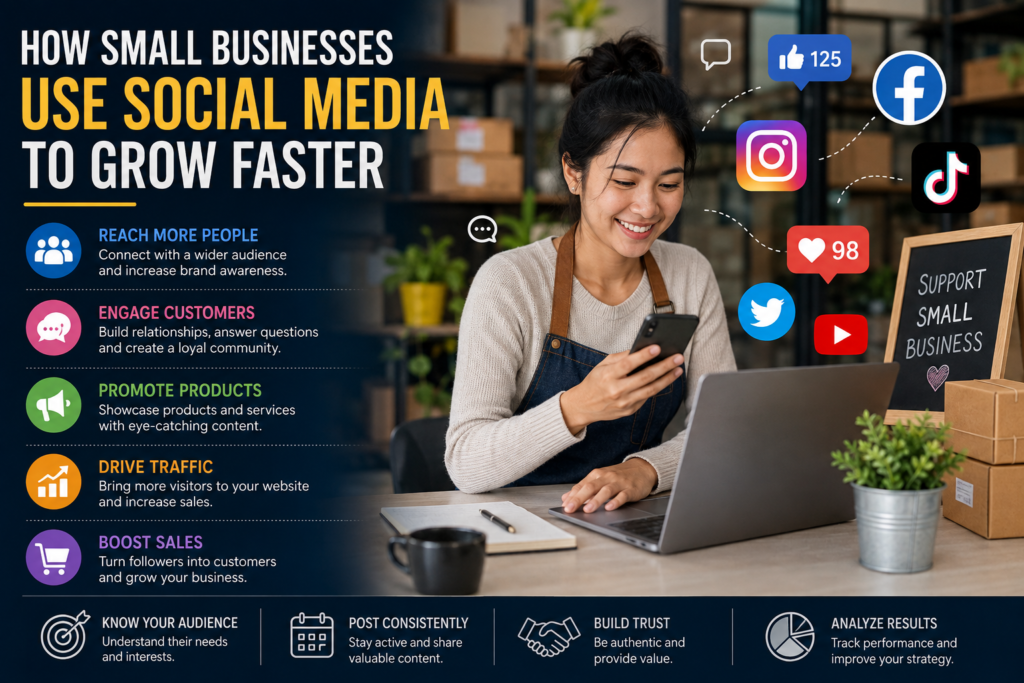
Small businesses hit strong competition in just about every industry. Finding new customers, building belief, and pushing revenue usually means you need a solid online presence. Social media gives small businesses a practical route to connect with customers, without burning too much money on the usual traditional ads.
In the end, social media for small businesses helps brands reach the right people, promote products, grow relationships, and basically generate sales. With a decent plan, a smaller business can still build a vibrant online community , and stand toe to toe with bigger brands, even if they have more reach.
Why Social Media Matters for Small Businesses
Social media is now a major marketing channel for businesses , it’s not just the big ones. Platforms like Facebook , Instagram, TikTok, LinkedIn, and YouTube give companies a more direct line to potential customers.
For small businesses , social media can bring:
- More brand visibility
- Real-time talk with customers
- Lower cost marketing chances
- More traffic to your site
- Stronger customer interaction
- More chances to sell
- Better brand stickiness
You don’t need millions of followers to get results. Often a focused audience that actually shows up , comments, shares, and interacts with your posts can be way more valuable than a huge crowd that isn’t really interested in what you offer.
Choose the Right Social Media Platforms
A first move, when using social media for small businesses, is figuring out which platforms match where your customers spend their time.
For example, a restaurant might get good traction from Instagram, Facebook, and TikTok. People like food pics, and short clips, they scroll through it fast anyway.
A professional consulting company might concentrate more on LinkedIn. That’s where conversations about services, credibility, and industry knowledge tend to land.
A local clothing store could lean into Instagram and TikTok to spotlight new
Create Useful and Engaging Content
Honestly, content is one of the most important parts of social media marketing, it’s kind of the thing that keeps people watching, clicking, and coming back. If your posts don’t give someone a reason to follow , or to comment, share, and interact then it gets kinda lost.
Small businesses can create different kinds of content, like:
- Product demonstrations
- Customer testimonials
- Behind-the-scenes videos
- Educational tips
- Industry news
- Frequently asked questions
- Short tutorials
- Product comparisons
- Customer stories
- Special offers
For instance, a bakery might post short videos showing how popular products get made , not just the final result. A fitness business could share simple workout suggestions that are easy to copy. Meanwhile, a local clothing store could make videos about multiple styling ideas, basically showing different looks with the same pieces.
When your content is actually useful it builds trust and keeps your business visible, even when people aren’t “searching” for you.
Use Short-Form Video
Short-form video is now a big deal for businesses that want more reach, and more interaction.
TikTok, Instagram Reels, and YouTube Shorts let you show products and ideas in a more direct way, without turning it into a whole production.
A small business might create a quick 20-second video, showing:
- How a product works
- A new product arrival
- A customer review
- A common problem and the solution
- A fast business tip
- A behind-the-scenes glimpse
Also, videos make it easier for customers to understand the human side of your business, like what you do day to day.
Build Relationships With Customers
Social media works better when you treat it like a conversation, not just a place to throw ads. It should be less “push” and more “listen,” you know?
Respond to comments and messages. Answer questions. Thank people for their feedback. If someone complains, respond professionally , and don’t ignore it.
Those little back-and-forth moments help customers feel your business actually cares, and that your opinions matter.
Social media for small businesses tends to work best when customers feel like they’re chatting with real people rather than an…
Use Local Content
Local businesses have an advantage, because they serve a particular community, you know… in a real way.
Use local content to connect with people around you. Mention your city or neighborhood in relevant posts. Share local happenings, and work with other businesses. Lift up local customers, and talk about community activities too, even small ones.
Like, a restaurant in Nairobi might post about local food preferences nearby events, and common times people go out for meals. Or you could say it another way: local content helps you show the vibe of where you are.
Local content helps businesses attract customers who are more likely to drop by, or make a purchase.
Work With Micro-Influencers
Small businesses often do not have the budget to collaborate with big influencers. Micro-influencers are a decent alternative.
Micro-influencers usually have smaller, but more tuned audiences. Their followers often have a real interest in a specific niche, product type, location, or even a style of living.
A small business could work with a local food creator, a fitness creator, a fashion creator, a travel creator, or a specialist within the industry. It can feel more natural, like a better match.
Before you work with any influencer, check their engagement, audience quality, previous content, and whether they truly connect with your target customers.
Encourage Customer-Generated Content
Customer-generated content gives small businesses genuine material, for their social feeds.
Ask customers to share photos, videos, reviews, or their experiences with your products. Then, if you get permission, feature their content on your business accounts.
This idea brings you two wins, not just one. It gives your business extra content, and it also shows potential customers how other people actually use your products or services.
Customer reviews and real moments often help new customers feel more confident about buying.
Use Social Media Advertising
Organic content matters, but paid ads can help small businesses reach specific audiences quickly, and that matters when time is tight
Most big social platforms have some targeting options, kind of like location , interests , age , behavior, plus different demographic profiles.
A neighborhood business might focus on people in a specific zone. Meanwhile an online store could aim for folks who seem interested in a certain product category.
Start with a modest ad budget. Try different images, videos, headlines, plus various audiences. Monitor what happens , then put more money into the campaigns that bring solid returns.
Track Your Results
If you post content but you do not measure performance, it gets hard to tell what actually works.
Some important social media numbers to watch include :
- Reach
- Engagement
- Follower growth
- Website clicks
- Video views
- Leads
- Sales
- Conversion rate
Try spotting patterns, like which themes or formats repeat with better outcomes.
If educational videos get more engagement than promotional posts, then make more educational videos. If product demonstrations lead to more website visits, lean into that kind of content, more and more.
Data makes your marketing calls less guessy and more smart.
Post Consistently
Being consistent helps keep your business in view of your audience.
You do not have to publish like several times every day. A steady plan, even if it is small, can be way more effective.
For instance, a small business might post like this :
Monday: Educational post
Wednesday: Product or service post
Friday: Short-form video
Sunday: Customer story or behind-the-scenes content
The best timing depends on your audience and what resources you actually have.
Turn Followers Into Customers
Growing followers can help, but follower counts by themselves do not automatically create growth.
Your social media plan should guide people toward practical actions.
Depending on your business, those actions may look like :
- Visiting your website
- Sending a message
- Booking an appointment
- Joining an email list
- Requesting a quote
- Visiting your store
Include a clear call to action right here, because, honestly , it makes a huge difference. Like, after you read, go do the next step. Visit our website to order or sign up for updates , don’t just scroll past.
Also if you see something you like, click the button and message us. Ask a quick question, get a fast answer , and then take action from there.
Common Social Media Mistakes Small Businesses Should Avoid
Some small businesses run into trouble online because they spend time on the wrong tasks, or they just do things without a plan. It’s not always about effort, it’s more about direction.
Common mistakes include:
- Posting without a clear strategy
- Using too many platforms at once, instead of going deeper
- Ignoring customer comments and questions
- Posting only promotional content, no helpful stuff in between
- Buying fake followers, which can quietly hurt your reach
- Copying competitors, instead of refining your own voice
- Ignoring negative feedback, even when it’s a chance to improve
- Failing to track results, metrics , and engagement trends
- Posting inconsistently, then wondering why growth stalls
- Using low-quality images and videos
Avoid these missteps so you can build a stronger, more professional online presence.
How Social Media Helps Small Businesses Grow Faster
Social media helps small businesses connect with customers, join communities, and access marketing tools that used to be harder to reach.
With a well-planned social media strategy, businesses can boost visibility, strengthen customer relationships, generate leads, and promote products without feeling pushy.
The key is consistency and measurement. Pick the right platforms, share useful content, talk with your audience, and then study what performs. If something works, repeat it. If it doesn’t, adjust it, quickly.
Social media for small businesses works best when you focus on authentic connections, not chasing follower numbers like they are the only scoreboard.
Frequently Asked Questions
What is the best social media platform for a small business?
The best platform depends on who you’re trying to reach, and what you actually sell. Instagram and TikTok tend to work well for visual products. LinkedIn is great for professional services. Facebook is still valuable for community-focused brands and local businesses.
How often should a small business post on social media ?
Honestly, don’t chase “everyday” too early. A schedule that’s realistic (and you can actually keep up with) matters way more than posting constantly. A good starting point is several quality posts per week, then tweak it based on audience engagement and what you have time, talent, and energy for.
Is social media marketing expensive ?
It can be, but it doesn’t have to be. Social media includes free , organic promotion and also paid options. Many businesses start with organic content first, then slowly add paid ads once they’ve learned what content and audiences really perform.
How long does social media marketing take to produce results ?
That depends on your industry, who you’re targeting, how strong your content is, which platform you’re using, and how consistent you are. Some folks notice better engagement quickly, but building a real, dependable customer base usually takes longer, more patience than people expect.
Should small businesses use paid social media advertising ?
Paid social ads can help if your goal is to reach a specific group, push an offer, bring in leads, or increase website traffic. Begin with a modest, controlled budget and then track what happens, not just clicks , but conversions and real outcomes.
What type of content works best for small businesses ?
Usually, educational content does well, plus short videos, customer reviews, product demos, behind-the-scenes glimpses, and practical tips. Try different formats because audiences often surprise you—sometimes a simple “how it’s made” video beats everything else for a while.
Conclusion
Social media gives small businesses a direct channel to reach customers and build longer term relationships. The most effective approach is usually the one that matches the right platform, focuses on useful content, keeps communication consistent, and includes regular performance checks.
If companies use social media for small businesses strategically, they can boost brand awareness, attract new customers, strengthen loyalty, and create additional chances for growth.