


Putting money into farmland used to mean big checks, hard expertise, and real-world property work. Online platforms have made it easier for some people to take part in this area of investing.
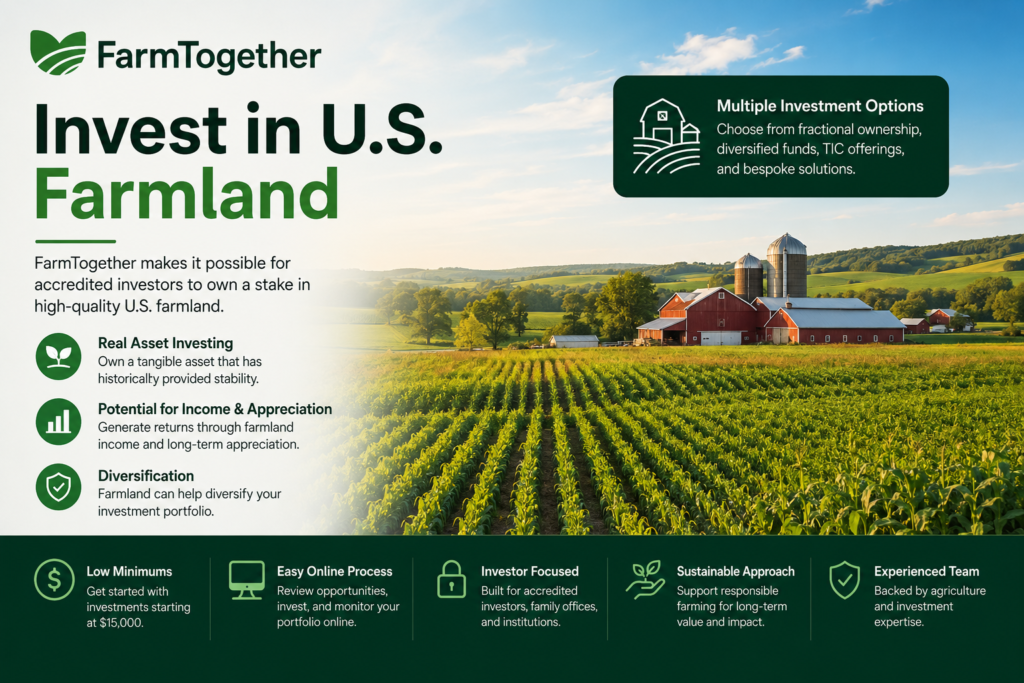
FarmTogether is a platform in the United States that works with accredited and institutional investors. It offers more than one way to invest. Some options are tied to specific farms in smaller pieces. Others are set up like a fund that holds a mix of farmland assets. There are also larger, more tailored ownership setups, based on the deal.
This is not like buying and selling shares each day. FarmTogether offerings are often private placements. Those can be tough to exit, and investors may need to leave funds in place for a long stretch. FarmTogether also warns that an investor might end up losing part of the money, or all of it.
In this write-up, you will find a walkthrough of how FarmTogether works. You will also see the main ways to invest, the possible upsides, key downsides, and what you should check before you join.
Note: This is for learning only. It is not financial advice, tax advice, or legal advice. Terms, who can invest, costs, and available products may shift. Read the latest official offering papers and talk with qualified professionals before you make any choice.
What Is FarmTogether?
FarmTogether is an online site that focuses on investing in U.S. farmland deals.
Rather than having you buy and run an entire farm by yourself, the platform uses different structures. These can give you an ownership interest in farmland, or another kind of exposure to farmland.
Rather than forcing the investor to purchase and operate an entire farm, there are various types of structures offered by the platform which will enable the investor to gain an interest in farmland or a portfolio of farmland investments.
According to FarmTogether, the following are some of the structures that could be available:
Crowdfunded farmland offerings
A Sustainable Farmland Fund
Tenancy in Common (TIC) offerings
Sole-ownership bespoke offerings
Separately Managed Accounts (SMAs)
There are significant differences in requirements between these offerings.
One key difference is that FarmTogether does not use the REIT structure. In the case of the crowdfunded offerings, the investor purchases an interest in an entity such as an LLC, which is a holder of the farmland.
How Does FarmTogether Work?
The idea is simple enough.
Farmland investment opportunities are identified by FarmTogether and are subject to due diligence; after which, they are structured and information about the investments are made available using the platform. Eligible investors can then browse through the opportunities and the information about the investment.
In the case of crowdfunded offerings, FarmTogether claims that the investors can select individual farmland investment opportunities and purchase fractional interests. At this time, the minimum investment for crowdfunded offerings of FarmTogether is at $15,000.
Investment Process:
- Create an Account
An investor creates an account and fills in the investor details.
- Verify Eligibility
At present, the majority of FarmTogether’s offerings are targeted at accredited investors but there are differences in requirements per product and investor location.
- Review an Investment
The eligible investor is able to review the information about a particular farmland offering which includes its structure, financial information, risk, fees and other documents.
- Select an Investment
If you find an option that fits, you can pick an allocation. Then you complete the forms that are required for the deal.
- Keep an Eye on It
After you invest, you can use the platform to view details tied to your portfolio.
The steps and the paperwork can change. It depends on the specific product you choose.
Who Is Allowed to Invest on FarmTogether?
This is a key part to get right.
FarmTogether says it works with accredited investors, family offices, advisors, and institutional investors across the world. Still, eligibility rules can vary by product. So not every offering will be open to the same group.
For many private deals in the U.S., a person may qualify as an accredited investor. This can be based on income, net worth, or certain job credentials. The SEC lists several ways to qualify. One route is income over $200,000 for an individual. Another is $300,000 if you file with a spouse or partner. That must be for each of the last two years, with a reasonable expectation of similar income in the current year. Another route is net worth over $1 million, not counting the main home.
So you should not treat FarmTogether like a simple app that any retail investor can use.
What Types of Investments Does FarmTogether Offer?
A notable part of the platform is that it uses more than one deal format.
Crowdfunded Farmland Deals
With this option, you can buy a fraction of ownership in a specific farmland investment.
FarmTogether shows a $15,000 minimum for these options. With this setup, people can pick specific properties. They do not automatically get a spread across many farms.
Some investors may like that approach. It gives them more say over which farmland assets to hold.
There is a downside too. Choosing single properties can raise concentration risk. Results may vary if one farm has a different crop, sits in a different region, or uses a different operating model than another.
Sustainable Farmland Fund
The Sustainable Farmland Fund gives exposure to farmland as a pooled portfolio. You make one allocation to get that exposure.
FarmTogether lists $50,000 as the minimum for Class A. It also lists a much higher minimum for Class I. The fund is open-ended. Its goal is broad diversification. It is not built for investors who want to choose each property.
So, in practice, it is not the same idea as picking individual farms.
Tenancy in Common Offerings
TIC offerings are another path to fractional ownership in farmland.
FarmTogether’s current product overview shows a $500,000 minimum for TIC offerings. It also notes that these may qualify for 1031 exchanges, if requirements are met.
Because 1031 exchanges follow strict tax rules, investors should get their own tax guidance. They should not assume every investment will automatically get the best tax outcome.
Sole-Ownership Bespoke Offerings
The bespoke option is made for investors who want direct ownership of a single farm. The farm is selected based on customized investment criteria.
FarmTogether lists a $3 million minimum equity investment per farm for this product.
Overall, it targets a very different type of investor than the other options shown.
FarmTogether could have some advantages for certain investors.
Special type of asset
If someone buys farmland on their own, they often need more money and more know-how. A site like FarmTogether may give a tighter process for looking at land deals.
Online steps
FarmTogether uses a digital flow. Investors can review listings, handle required paperwork, and keep track of what they own.
Multiple ways to invest
Depending on who qualifies and what is offered, investors might be able to choose among single-property deals, pooled funds, TIC options, or tailored setups.
Possible portfolio mix
Farmland may be one part of a wider portfolio. Even so, the real question is how it fits into a full financial plan. Just owning more than one farm does not automatically mean the risk is spread well.
Tied to something physical
Public stock is not the same as land. Farmland is a real asset you can point to. It is not risk-free, but its behavior can differ from other financial products.
Key risks tied to FarmTogether
You should weigh risks alongside any hoped-for gains.
- Not easy to exit
Land usually takes time. FarmTogether notes that its offerings are private placements and can be hard to sell. It also says people should plan for long time frames. In its current offering details, it lists an eight to twelve year target hold period.
That setup is unlike a public stock, which can often be sold during regular trading hours.
The SEC notes that private placements are hard to sell later. It also says some investors might have to keep restricted securities for a long time.
Agricultural Risk
Farming relies on factors outside an investor’s control.
Weather can shift quickly. Drought, heavy rain, flooding, pests, crop disease, and limited water all play a role. Rules can change too. Input costs can rise. Supply-chain problems can disrupt delivery. Consumer demand can also move. FarmTogether points to these and other risks in its own disclosures.
Property Valuation Risk
An investor may lose money if farmland is bought at a poor price. Loss can also happen if the sale price later ends up lower than expected.
Even a property chosen with care can still see price swings. Local economic trends matter. Interest rates matter. Agricultural demand matters. Water access matters as well. Other conditions can contribute too.
Operator Risk
Farmland is not just land held as an asset.
Farms need skilled operators. They also need strong management. If operations are run poorly, results can suffer. That can affect production, costs, lease terms, and the final investment outcome.
Fees
Fees can lower total returns.
FarmTogether says fee levels depend on the product and the specific deal. It also says the available materials show different fee setups for different products. Because of that, investors should check the fee chart tied to a given opportunity. They should not assume one general figure fits everything.
No Guaranteed Returns
FarmTogether’s offerings are not guaranteed. They are not like a bank deposit.
In the disclosure, the company says the private placements are not FDIC-insured and could fall in value. This matters when comparing farmland investments with savings accounts or other options meant to protect capital.
That difference matters a lot when you compare farmland deals to savings accounts or other options made to protect capital.
FarmTogether vs. Buying Farmland Directly
Using a platform is not the same as buying land on your own. There are real gaps between the two.
| Factor | FarmTogether | Buying Farmland Direct |
|---|---|---|
| Property choice | Based on what the platform offers | You pick the land |
| Ongoing management | The deal setup usually organizes management | You run it or hire someone |
| Money needed | Depends on the product | Often very high |
| Checking the details | The platform handles underwriting and papers | You do it, or you pay others to do it |
| Spreading risk | Some products allow it | Usually you must buy several parcels |
| How fast you can exit | Usually hard to exit | Even land sales can take time |
| Your role | Depends on the terms | You may need to be more hands on |
Neither path is always better.
What fits you depends on your goals, how much cash you have, your timeline, your background, what level of risk you can handle, tax details, and whether you can do due diligence yourself.
What to Review Before You Invest
If you qualify to invest in FarmTogether and you are reading up on it, do not stop with the big return numbers.
Go Through the Offering Papers
Read the private placement memorandum and any other related documents.
The SEC urges investors to focus on the risks, the fees, any limits, the financial details, the people running the deal, and the terms that control the investment.
Know the Ownership Setup
Clarify what you actually hold.
For example, is it an interest in an LLC, a fund share, a TIC interest, or something else?
The legal format can change your rights, how money is paid out, the tax treatment, and how easy it is to get out later.
Legal setup changes what you get, how money is shared, what taxes may be owed, and how easy it is to move out of the investment.
Check the Fees
Do not stop at the lowest number you see in ads.
Go line by line through the charges tied to the deal. Look at acquisition costs, management fees, incentive or performance fees, admin costs, and any other items that can show up for that specific offering.
Look Closely at the Property
Before you commit, think about these items:
- Where the land is
- What crop is planned
- How water is provided
- Soil quality and limits
- What was done on the land in the past
- Lease terms and how they are set up
- Who runs the farm day to day
- Any debt on the farm, or added leverage
- Insurance terms
- How long you expect to hold it
- How you expect to exit
Watch Concentration
If you put most of your capital into one farm, one crop, or one region, the portfolio can swing more than you expect.
A diversified farmland fund may lower some of that risk. But then you lose the chance to pick specific properties yourself.
Think About Liquidity
Ask it in a plain way:
Can you leave this money tied up for multiple years, even if you do not know what will happen next?
If you would need access to the cash soon, an illiquid private deal may not match your situation.
Is FarmTogether a REIT?
No.
FarmTogether says it is not a REIT. Its crowdfunding deals usually give investors an ownership stake in an entity that holds the farmland. A REIT uses a different legal and investment design.
Because of that, you should not treat FarmTogether deals as if they have the same liquidity, tax handling, reporting style, or other traits as public REITs.
Is FarmTogether Safe?
It is better to ask a more useful question. Is a given FarmTogether investment a fit for your comfort with risk and your own financial needs?
FarmTogether shares due-diligence material and points out risks tied to its offerings. But the company also states that it explicitly warns about
Frequently Asked Questions
- What is FarmTogether?
FarmTogether is a platform for investing in farmland online. It offers access to U.S. farmland for eligible investors. It uses different deal types, such as fractional offerings and farmland funds. - What is the minimum investment on FarmTogether?
The starting amount changes based on the product. FarmTogether lists $15,000 for crowdfunded offerings. It lists $50,000 for Class A interests in its Sustainable Farmland Fund. It lists $500,000 for TIC offerings. It lists $3 million for bespoke sole-ownership offerings.
These amounts may be updated. You should check the latest details with FarmTogether before you invest.
- Do you need to be an accredited investor?
FarmTogether says its offerings are for accredited investors. That said, the rules can differ by product. They can also depend on your investor status.
The SEC also sets its own accredited-investor criteria.
- Can you lose money investing through FarmTogether?
Yes. FarmTogether notes that the investments carry risk. It also says investors should expect the chance of losing some or even all of the money they put in. - How long do FarmTogether investments last?
The timeline depends on the specific investment. FarmTogether currently lists a target hold time of 8 to 12 years for its crowdfunded offerings. Other products may have different terms.
Before you commit funds, review the offering documents for that deal.
Final Thoughts
FarmTogether gives eligible investors a structured way to get exposure to U.S. farmland. You do this without owning and running a full farm by yourself. It offers several types of investments, from fractional farmland deals to funds and tailored sole-ownership arrangements.
You can mix several farmland approaches here. Some people buy small farm slices. Others join pooled vehicles. Some deals are built as custom ownership. This gives eligible investors a way to match what they want.
Even so, farmland investing is not like a basic savings plan with low risk. Private farmland deals can tie up your cash for a long time. Many require a big initial check. There are also a lot of moving parts. Crop and land conditions matter. Daily farm work matters. Crop prices can swing. Demand can change. Property value can shift. Legal rules can affect outcomes. Weather can ruin plans.
If you are looking at FarmTogether, do not stop at the top rate claims. Spend time on the ownership setup. Then look at the fee list and how it is laid out. Confirm the typical hold period and what happens if you want out early. Read the farm details too, including tax items. Also find any caps or limits on selling.
Before you sign anything, read the newest offering documents and the official disclosures. The SEC also tells investors to pay close attention to the risks in private offerings. It points out that these deals can cause major losses.